
James Daley
I build software systems, research frameworks, applications, and architecture under the Raven Forge name — my personal digital portfolio and project home.
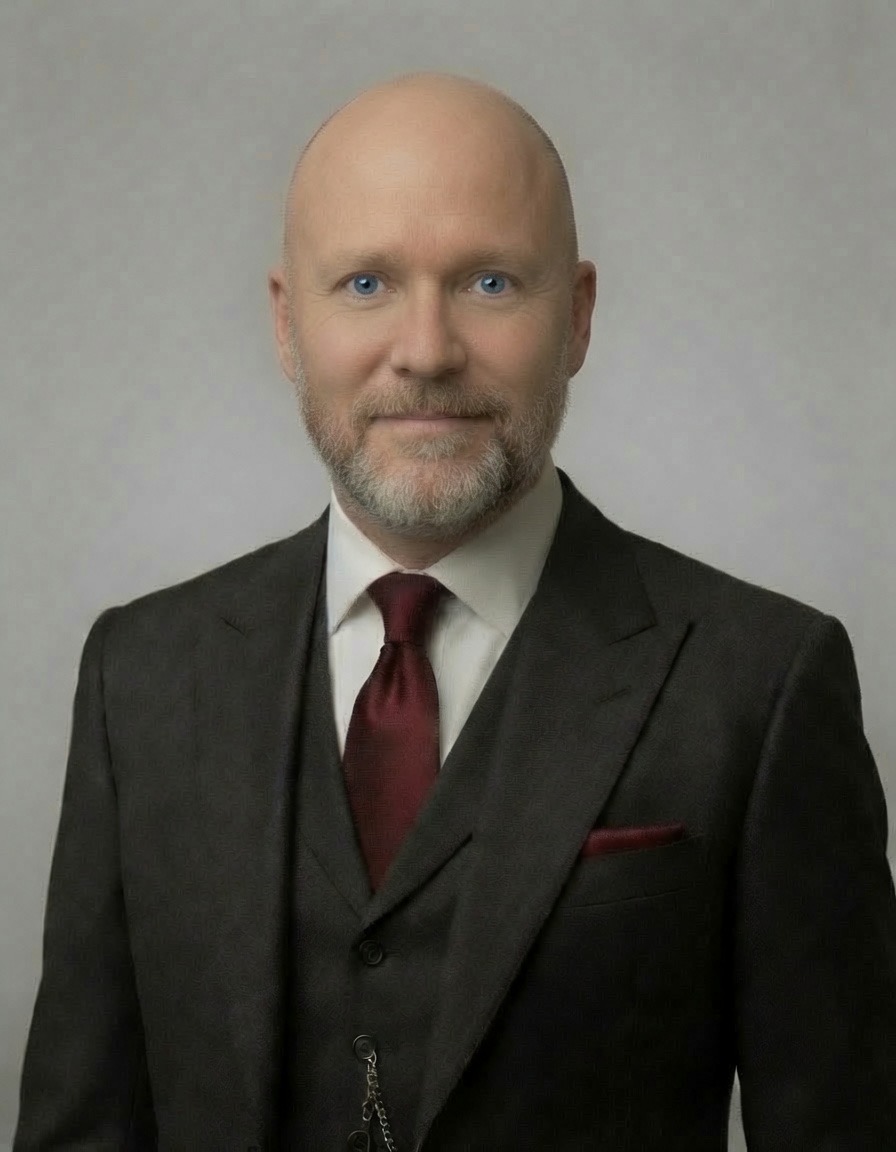
James Daley
Author, Developer, and Systems ArchitectI am James Daley, the author, developer, and systems architect behind Raven Forge. I am a full-stack developer, engineer, and author driven by a singular instinct: to find the underlying structure of a thing and build from first principles. Across software, systems architecture, cosmology, and literature, my work returns to the same essential pursuit—pattern, coherence, and the disciplined shaping of complexity into form.
The ASH Model & a Foundational Realization
That pursuit led me to develop the ASH Model, a cosmological framework centered on structure, information, and existence. What began as a theoretical model became something more consequential: a practical lens through which systems, intelligence, and creation itself could be understood. The insight was simple, but far-reaching. Durable things do not emerge from noise alone. They endure through order, relation, and internal coherence.
That realization became foundational to everything I built next.
From Hobby Project to Architectural Discipline
What began as a hobby project—the Yggdrasil World Engine—quickly revealed a deeper technical problem. As modern AI systems accelerated software development, they also exposed a dangerous weakness. They could generate quickly, but they could also drift. They could produce output without architecture, speed without discipline, and complexity without integrity. For me, that was never a minor inconvenience. In software, structure is not cosmetic. Structure is what determines whether a system can endure.
In response, I created the Forsetti Framework: a modular, object-oriented foundation designed to keep AI-driven development aligned with strong architectural principles, maintainability, and long-term stability. As agentic coding matured, I recognized its real significance. Its power was not merely automation. Its power was multiplication—the ability for one architect to direct the output of many specialized intelligences.
But force without governance is still unstable.
Agentic Development, Under Discipline
So I built the next layer: Forsetti Agentic Edition, a governance system designed to direct AI coding tools within defined architectural boundaries, enforce framework compliance, and prevent the shortcuts and incoherence that often undermine unmanaged agentic development. The result was not simply faster software production, but a stronger development model—one capable of producing software that is modular, stable, secure, and efficient by design.
From there, the vision evolved into orchestration.
The Conductor Behind the Orchestra
I developed the Master Control Orchestration Layer Server (MCOLS), together with the Command Logic Unit and the Hugin and Munin agent modules, to enable AI development tools to share information, coordinate execution, and operate as a disciplined system rather than a collection of isolated tools. MCOLS has since been parked in favor of Forge Conductor, an orchestration layer that better meets my needs in the short term. Forge Conductor comes in multiple forms: on Windows it runs as a lightweight orchestration stack on a RAM disk; on Mac it is a full native application. I have open sourced both versions, preserving the same emphasis on framework alignment, architectural consistency, and modular object-oriented design.
Aeostara — Endurance by Design
I later created Aeostara, a self-healing, self-correcting engine designed to preserve continuity in the presence of bad updates or destabilizing failures. Its purpose is both technical and strategic: to ensure that a system can recover rather than collapse. That kind of resilience has implications well beyond conventional software, extending into industrial safety, mission-critical infrastructure, aerospace, and defense—fields where reliability is not a preference, but a requirement.
Ennea AI — Sovereign Intelligence
My most ambitious undertaking is now Ennea AI.
Ennea is designed as a self-learning, self-healing, self-pruning intelligence architecture with the potential to move beyond narrow machine behavior toward something more adaptive, durable, and sovereign. It is built to scale without losing its coherence: capable of running locally on a smartphone or expanding outward into datacenter-scale deployment. Just as important, it is built around a principle I see as central to the future of AI: true intelligence should not belong exclusively to centralized institutions. It should also be something individuals and organizations can shape, govern, and retain closer control over for themselves.
Author, Developer, and Systems Architect
I use Raven Forge as the public home for my software engineering, systems architecture, application development, and applied research. My role is to guide the long-range direction of the work, shape the underlying architecture, make the core implementation decisions, and continue advancing the systems and ideas at the heart of Raven Forge.
Raven Forge is my personal brand and independent project home. It is not affiliated with any current or previous employer, and the work presented here reflects my own software engineering, architecture, and research interests.
The Written Worlds

Jim Daley Books
Under the pen name Jim Daley, I write fiction and memoir grounded in the same ASH model that underpins my software. What began in 2023 as a short story about my twenty-two years as a police officer — and my battle with complex PTSD — grew into a layered, nine-plane cosmology. That research now feeds both my worlds and my systems.
- Where Ravens Wait — a nine-plane mythic cosmology of Yggdrasil, the Void and Celestial realms, Wolves, and Vessels
- The Guardian, The Angel, and The Goddess — a memoir of policing, trauma, and redemption
- Worldbuilding and lore derived from the ASH model
- Serialized chapters and essays on the blog
The Raven Forge Way
That is the philosophy behind my work at Raven Forge.
I am not building Raven Forge around disposable output, passing trends, or undisciplined acceleration. I am building it on the conviction that the future belongs to systems with structure, intelligence with governance, and creation disciplined enough to endure.
Want to Connect?
I welcome conversations about technology, architecture, Raven Forge projects, Rune Scribe, and the future of disciplined software development.